


The Infinite Excellence (ie4) Healthcare Quality Framework (ie4-HQF) is a comprehensive, systems-based model designed to unify disparate dimensions of healthcare quality into a single, actionable governance architecture. The framework positions the patient at the centre of all quality activities, surrounded by three interconnected primary domains: Patient Safety and Risk Management, Quality Audit and Compliance, and Performance and Excellence.
The model ingests six categories of regulatory and community inputs, spanning federal and international accreditation standards to patient expectations, and converts them into six defined quality outputs, culminating in High Reliability Organisation (HRO) status. Structured around a continuous improvement cycle of identification of opportunities, strategy development, process improvement, compliance measurement, outcome documentation, and reporting, the ie4-HQF offers a scientifically grounded, practically deployable pathway to sustainable, measurable excellence.
Introduction: The Quality Imperative in Modern Healthcare
Healthcare organisations worldwide operate under increasing pressure from regulators, payers, patients, and international accreditation bodies to demonstrate not only clinical competence but systematic, measurable excellence. The World Health Organization estimates that in high-income countries, adverse events occur in approximately 1 in every 10 hospital admissions, while in low- and middle-income settings the burden is disproportionately higher.
The ie4-HQF responds directly to this imperative. Rather than treating quality as a departmental function, it conceptualizes quality as an organisational ecosystem centred on the patient and governed by interlocking domains of audit, analytics, safety, risk, and institutional excellence.
Quality is not an act, it is a habit, and in healthcare, it is a system. The ie4-HQF operationalizes that system, transforming the abstract commitment to excellence into a living architecture that organisations can inhabit, measure, and continuously improve.Infinite Excellence (ie4) QUALExcel Framework Principles, 2025
Framework Architecture: The Concentric Systems Model
The ie4-HQF is represented as a concentric circular model, a deliberate architectural choice communicating three design principles: centrality of the patient, interdependence of quality domains, and continuity of the improvement cycle. At the absolute core sits the Patient, supported by Staff, Family, and Friends. Every audit, every risk register entry, every performance indicator, and every strategic initiative must trace its rationale back to a patient-level impact.
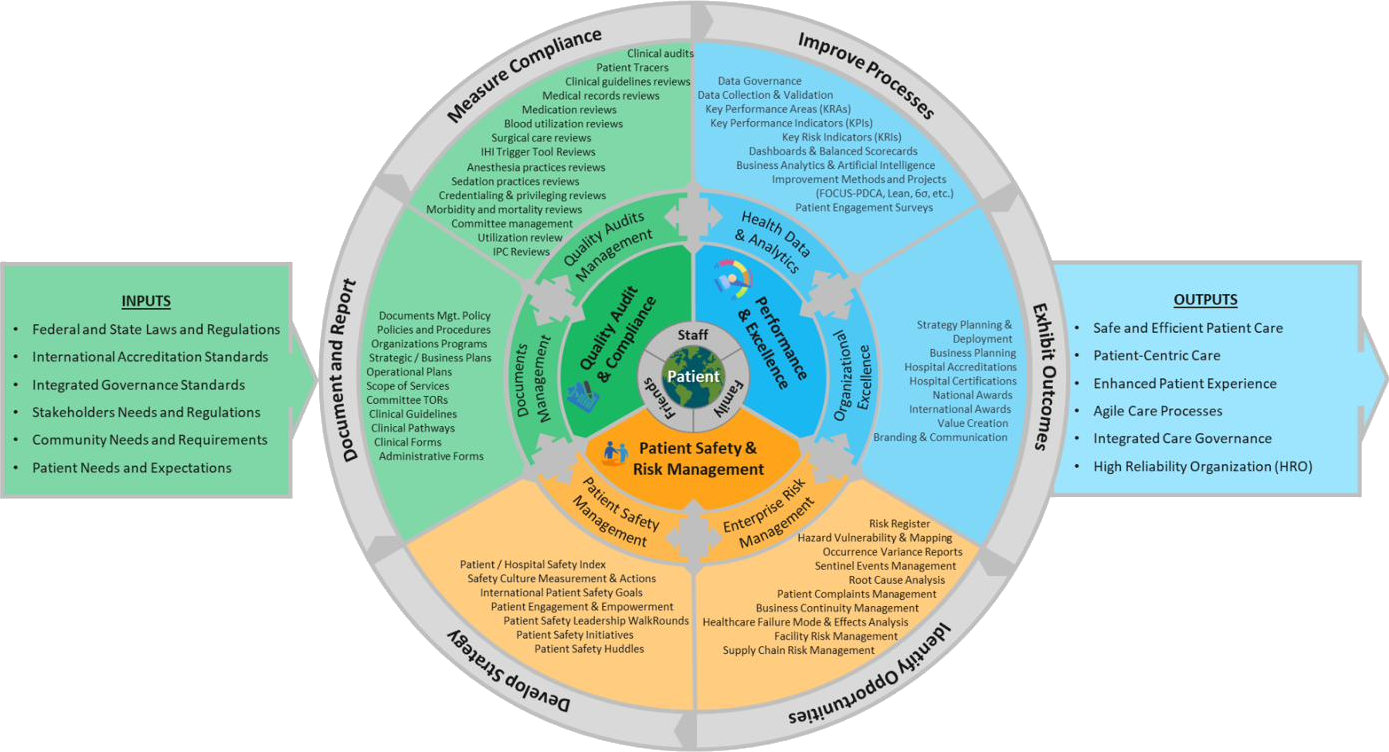
Surrounding the patient core are six operational domains that constitute the primary drivers of quality work, each with its own tools and accountability mechanisms:
Patient Safety Management
Patient safety indices, safety culture measurement, International Patient Safety Goals, patient engagement, leadership WalkRounds, and safety huddles.
Quality Audit & Compliance
Clinical audits, patient tracers, medication reviews, credentialing, and morbidity & mortality reviews.
Health Data & Analytics
Data governance, KPIs, KRIs, balanced scorecards, and AI-driven analytics supporting FOCUS-PDCA, Lean, and Six Sigma.
Enterprise Risk Management
Risk registers, hazard vulnerability mapping, sentinel event management, root cause analysis, HFMEA, and business continuity.
Documents Management
Policies, clinical guidelines, pathways, scope of services, and committee terms of reference, the connective tissue of every quality activity.
Organisational Excellence
Strategy planning and deployment, accreditation, national and international awards, and value creation.
| Domain | Key activities | Standard alignment | Evidence level |
|---|---|---|---|
| Patient Safety Management | IPSGs, safety culture, WalkRounds, patient empowerment | WHO Global Patient Safety Challenge, IHI HRO | Level I |
| Enterprise Risk Management | Risk register, HFMEA, sentinel events, RCA, business continuity | ISO 31000:2018, NPSF, CMS CoP | Level I |
| Quality Audit & Compliance | Clinical audits, patient tracers, medication reviews, credentialing | JCI, CBAHI, CCHSA, ISO 9001:2015 | Level I |
| Documents Management | Policy governance, clinical pathways, committee TORs | Accreditation standards, ISO 9001 | Level II |
| Health Data & Analytics | KPIs, KRIs, dashboards, FOCUS-PDCA, Lean, Six Sigma | IHI Quality Framework, Donabedian Model | Level I |
| Organisational Excellence | Strategy deployment, accreditations, certifications | EFQM, Malcolm Baldrige, ISO 9004:2018 | Level II |
Input-Output Architecture: From Regulation to Reliability
A defining feature of the ie4-HQF is its explicit articulation of the inputs that drive the quality system and the outputs it must produce, transforming the framework from a descriptive model into a value-creation engine that traces accountability from legislative requirement through to measurable patient outcomes.
| Inputs | Outputs |
|---|---|
| Federal and state laws and regulations | Safe and efficient patient care |
| International accreditation standards | Patient-centric care |
| Integrated governance standards | Enhanced patient experience |
| Stakeholder needs and regulations | Agile care processes |
| Community needs and requirements | Integrated care governance |
| Patient needs and expectations | High Reliability Organisation (HRO) |
The Continuous Improvement Cycle
The outer ring of the ie4-HQF encodes a six-phase continuous improvement cycle: Identify Opportunities, Develop Strategy, Improve Processes, Measure Compliance, Document and Report, and Exhibit Outcomes. Unlike linear quality models, the circular architecture communicates perpetual motion. Improvements feed back into opportunity identification, creating a self-reinforcing learning system. This aligns structurally with Deming's PDCA cycle, extended to incorporate the strategic planning and external accountability dimensions essential in healthcare's complex regulatory environment.
The High Reliability Organisation Destination
High Reliability Organisations are characterized by five core principles from the foundational work of Weick and Sutcliffe: preoccupation with failure, reluctance to simplify, sensitivity to operations, commitment to resilience, and deference to expertise. Healthcare systems pursuing HRO transformation, including Intermountain Healthcare, Mayo Clinic, and the Michigan Keystone Center, have demonstrated sustained reductions in preventable harm events.
Implementation Considerations
Successful deployment requires attention to several interdependent dimensions. Leadership commitment is non-negotiable: Patient Safety Leadership WalkRounds are effective only when senior leaders engage authentically and findings are visibly acted upon. Data infrastructure must be sufficient to support the Health Data and Analytics domain. Organisations lacking mature data governance may need a phased implementation, beginning with basic KPI dashboards before progressing to AI-driven analytics.
The Documents Management domain, often underestimated as administrative overhead, is structurally foundational. Without standardised policies, clinical pathways, and scope-of-service documents, audit activities lack the standards against which compliance is measured, and risk activities lack the protocols whose deviations constitute reportable events.
Conclusions
The ie4-HQF represents a scientifically coherent, operationally comprehensive, and strategically ambitious model for healthcare quality governance. By positioning the patient at the structural centre, articulating explicit input-output relationships, distributing responsibility across six complementary domains, and embedding all activities within a continuous improvement cycle, it offers organisations a complete architecture for the pursuit of High Reliability Organisation status, aligned with JCI, ISO 31000, WHO Patient Safety Goals, IHI HRO principles, and the EFQM Excellence Model.
The ie4-HQF does not ask healthcare organisations to do more, it asks them to do what they already do, but in a unified, patient-centred, evidence-aligned system that makes every activity count twice: once for compliance, and once for continuous improvement.
References
- World Health Organization (2024). Global Patient Safety Report 2024. WHO Press, Geneva.
- Weick KE, Sutcliffe KM (2011). Managing the Unexpected: Resilient Performance in an Age of Uncertainty. John Wiley & Sons.
- Griffin FA, Resar RK. IHI Global Trigger Tool for Measuring Adverse Events, 2nd Edition. IHI, 2009.
- Joint Commission International (2024). JCI Accreditation Standards for Hospitals, 8th Edition.
- International Organization for Standardization (2018). ISO 31000:2018: Risk Management Guidelines.
- Kaplan RS, Norton DP (1996). The Balanced Scorecard: Translating Strategy into Action.
- Donabedian A (2005). Evaluating the Quality of Medical Care. The Milbank Quarterly, 83: 691–729.
- EFQM (2020). EFQM Model 2020. European Foundation for Quality Management, Brussels.